
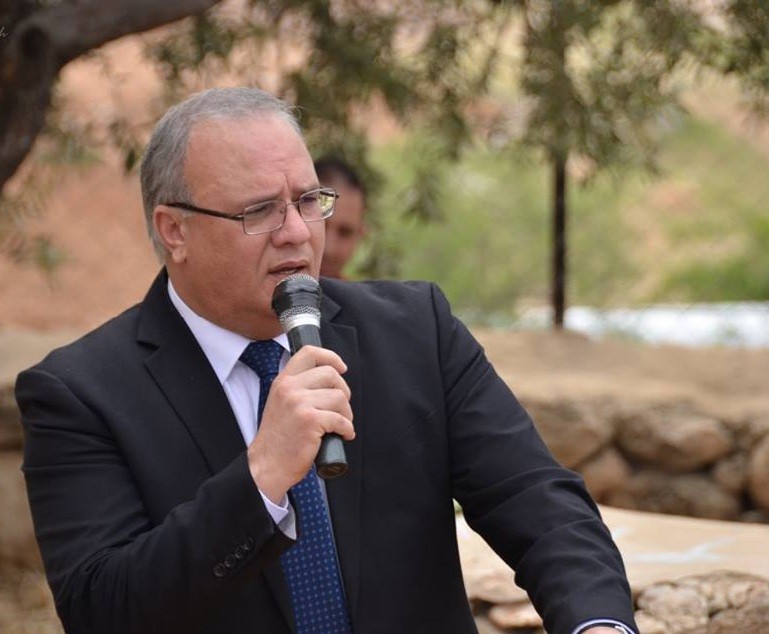
We are happy to have the opportunity to speak with a scholar and public servant whose life’s work has been devoted to the preservation of culture, memory, and human dignity under some of the most difficult circumstances imaginable. We are genuinely grateful that he has accepted our invitation. The questions we bring to this conversation are difficult ones. They are not about politics; rather, they concern us as human beings: what we have lost, the systems that have eroded our capacity to listen, to see, and to choose what is right and just.
Social media have constructed ecosystems in which individuals are exposed only to what they already believe – the so-called “echo chambers.” What is particularly striking, however, is that political discourse itself has increasingly adopted the same logic: the hyper-simplification of complex realities, the radicalisation of messaging, and the designation of an enemy. As a scholar and intellectual, at what point did you recognise that this communicative model was becoming entrenched? And to what extent do you believe it has made the intolerable possible – or at least bearable?
I do believe that there is more to genuine dialogue than simple connectivity; it should involve intellectual humility, moral courage, and a willingness to encounter difference without hostility. If social media is to unite humanity rather than fragment it, it must boost critical reflection, empathy, and exposure to diverse viewpoints, instead of simply feeding individuals what they already wish to hear. In order to avoid the hyper-simplification of complex realities, people need to step outside their traditional thinking and genuinely question what they take for granted.
I began to see this transformation clearly when public discourse, in all its forms, moved away from understanding grounded in objectivity, justice and shared humanity, and shifted toward emotional mobilization, blind hatred, fear-driven narratives, and the creation of an “enemy.” In this way, complexity of human nature comes to be seen as weakness, while blunt simplification and emotional immediacy turn out to be the dominant tools of political and media influence.
What concerns me most is not only the issue of “echo chambers,” but how dehumanization has become normalized through language itself. History shows that major tragedies begin with words before they turn into actions. As the philosopher Hannah Arendt warned: “The most dangerous form of evil is the one that becomes ordinary and acceptable”. When human suffering is reduced to numbers or headlines, societies slowly lose their moral sensitivity toward human pain. One can realize the depth of this crisis when influencing emotions becomes more important than the truth, and when the focus shifts from understanding reality to mobilizing people. That is both an intellectual and a moral failure.
I do believe that universities and intellectuals have a responsibility to defend critical thinking and preserve the human dimension of public discourse. Societies that lose empathy and dialogue risk losing their humanity. As Nelson Mandela once said: “No one is born hating another person because of the color of his skin, or his background, or his religion. People learn to hate, and if they can learn to hate, they can be taught to love”.
You served as the Palestinian Minister of Social Development from 2015 to 2019 before going on to lead the largest university in Palestine. During those years, what did it mean to preserve and cultivate culture, education, and social cohesion? And today, witnessing what is unfolding, what do you believe has been irretrievably lost – not only in material terms, but also in terms of memory, narrative, identity, and the very possibility of imagining a future?
When I assumed responsibility for the Ministry of Social Affairs (in 2015) and Development (as it is called now), the focus was mainly on financial aid without addressing the root causes of poverty. For that reason, we initiated a comprehensive reassessment of the Ministry’s philosophy and vision by forming specialized teams aimed at shifting society from a culture of dependency and need toward one of empowerment, productivity, and self-reliance.
This is why, in cooperation with our partners, we changed the Ministry’s name from the “Ministry of Social Affairs” to the “Ministry of Social Development” to reflect the new vision. People need not only assistance, but also opportunity, dignity, and the ability to shape their future. As Mahatma Gandhi once said: “Poverty is the worst form of violence”. Our goal was to address multidimensional poverty, empower vulnerable people, and promote sustainability, work, and productivity instead of long-term reliance on aid.
For us, true social development meant liberation from poverty, ignorance, and injustice; it also meant protecting dignity and strengthening resilience. We supported vulnerable families, empowered women and youth, and improved social protection systems. True development is not just economic; it is about living with dignity, stability, and hope.
In Palestine, development is also about survival; supporting families, preserving cultural initiatives, empowering women, and investing in younger generations are all forms of resisting despair and protecting collective identity. As Edward Said noted: “The struggle is not only over land, but also over narrative and memory”.
I strongly believe that societies live through their memory as much as through their institutions. When people lose their homes, schools, neighborhoods, and cultural centers – the very spaces where memories are created and passed between generations – the loss becomes profoundly human and civilizational before it is material. Therefore, reconstruction should never be limited to rebuilding stone and infrastructure alone; it must begin with preserving human dignity and ensuring social and economic security as essential foundations for protecting identity, narrative, and human connection.
I have always believed that the loss of dignity, food security, and social stability gradually leads to disengagement from public life and, ultimately, to the erosion of belonging itself. This is the greatest danger, because the most devastating loss a people can suffer is not merely the loss of land or infrastructure, but the fragmentation of collective memory and faith in their own future.
Despite everything, experience has proved that the Palestinian people remain deeply connected to their history and identity. New generations continue to carry this narrative forward. As Mahmoud Darwish wrote: “On this land, there is that which deserves life”. In many ways, this sentence captures the essence of the entire Palestinian narrative.
If you were to identify one concrete change – whether in education systems, journalism, or cultural institutions – that could restore people’s capacity to pause, what would it be?
I believe the most important change would be restoring moral and human context to public discourse. Modern media often presents suffering in fragments – statistics without faces, headlines without memory, and images without historical or ethical context. Over time, this can normalize tragedy and weaken our moral sensitivity.The philosopher Hannah Arendt warned that some of the greatest political dangers come from the gradual loss of our ability to think ethically about others. In the same spirit, Albert Camus reminded us that true generosity toward the future begins with how we respond to the present. Education should therefore aim not only to produce skilled professionals, but also ethically aware citizens. History should be taught through individual and collective human experience as much as through wars, borders, and treaties. I believe every university, newsroom, and cultural institution should institutionalize spaces where people encounter human stories deeply and critically: literature, testimony, documentary film, philosophy, history, and meaningful dialogue across differences. Not to produce agreement, but to produce conscience.
Journalism should resist reducing people to numbers or temporary trends. The problem today is not that humanity lacks information. We are drowning in information, coming from different kinds of media. The deeper crisis is spiritual and moral: people are losing the capacity to feel responsible in the presence of suffering repeated endlessly before their eyes. Cultural institutions should create spaces where people can truly encounter one another’s stories and recognize shared dignity and vulnerability. Indifference begins when suffering becomes abstract. The answer is not more information alone, but stronger moral imagination – the ability to see ourselves in the experience of others. If we can restore that pause – that moment where a person still sees another human being not as a statistic, enemy, or distant image, but as fully human – then indifference becomes harder, and complicity becomes morally unbearable.
As Dostoevsky wrote, “Each of us is responsible for all”. I believe that civilizations should be ultimately judged by whether they preserve that inner space of conscience, not by destroying it through noise, fear, propaganda, and exhaustion. However, I believe that no meaningful external reform can endure unless it instigates within the human being himself or herself. Laws may regulate behavior, institutions may shape systems, and media may influence perceptions, but genuine moral transformation originates in the inner self – in awareness, conviction, empathy, and the courage to examine one’s own conscience. A society cannot become more humane if individuals are emotionally disconnected from the suffering of others. Overall, in education, this means teaching students not only how to succeed, but how to recognize dignity. In journalism, it means restoring depth over speed, and human truth over spectacle. In culture, it means defending art that humanizes rather than numbs. It would be frightening when ordinary people gradually normalize witnessing the suffering of others, as occurred in Gaza. What protects societies is therefore not information alone, but empathy and moral reflection – the ability to pause and ask: What does this suffering mean for our common humanity?
Many individuals feel powerless on their own, convinced that their voice carries little weight. Yet when they join protests or collective movements, they often find themselves absorbed into political agendas that do not truly represent them. This creates a paralyzing dilemma for civic participation. In your view, is there an effective way to transform widespread public discontent into genuine pressure on political decision-makers, without it being co-opted or neutralized by the very systems it seeks to challenge?
This is one of the central moral and political dilemmas of our time. Many people feel trapped between two difficult realities: alone, they feel powerless; together, they fear being absorbed into political agendas they do not fully represent. Yet meaningful civic action is still possible when movements preserve ethical clarity, intellectual independence, and long-term social responsibility.Real pressure for change is rarely created by emotion alone. It comes when civil society, universities, labor organizations, journalists, artists, legal advocates, and grassroots communities sustain forms of engagement that political systems cannot easily dismiss. The goal should not simply be visibility, but credibility, continuity, and moral consistency. Vaclav Havel spoke about “the power of the powerless” – the idea that truth, conscience, and civic integrity can gradually reshape public life, even under systems that seem immovable. People should also resist the idea that participation matters only if results are immediate. Many of humanity’s most important achievements were built through long periods of patient moral persistence. Today, one of the greatest dangers is exhaustion, cynicism, and the commercialization of outrage. Democracies and institutions can survive only if independent spaces for ethical thinking and civic reflection remain alive beyond polarization and manipulation. As Martin Luther King Jr. said, “The arc of the moral universe is long, but it bends toward justice”.
Could you recommend a book and/or a film that might help international audiences grasp the historical, human, and political dimensions of what people experience, during a war?
Book Recommendation: as you know, the Palestinian question is deeply rooted in a long, complex, and multidimensional history that encompasses political struggle, human suffering, cultural resilience, and a rich civilizational heritage. For that reason, it is not easy to identify a single book that fully captures the depth of the Palestinian experience. However, if I were to suggest one particularly insightful and influential work in response to your question, I would recommend The Question of Palestine because it is much more than a political text. It is a deeply intellectual and human attempt to restore visibility, dignity, and historical voice to a people who are often spoken about but not sufficiently heard. Edward Said does not approach Palestine only as a territorial or diplomatic issue. He approaches it as a question of humanity, memory, representation, and moral recognition. What makes the book influential is its intellectual seriousness and civilized tone. Said writes through scholarship, literature, philosophy, and historical reflection rather than hatred or revenge. At its core, the book insists that Palestinians are not simply a demographic statistic or a geopolitical issue, but human beings with history, culture, aspirations, suffering, and the universal desire for dignity and belonging. It also bridges worlds: Said speaks in a language accessible to international audiences while remaining deeply rooted in the Palestinian experience.
Importantly, The Question of Palestine does not simply ask readers to “take sides.” It encourages them to think critically about how history is narrated, whose voices are amplified or silenced, and how power shapes public understanding.
Film Recommendation: once again, the Palestinian library is rich with local and international films and documentaries. However, in response to your question, I would recommend 5 Broken Cameras because it moves beyond political argument and reaches something more universal: the dignity of ordinary human life under extraordinary pressure. The film does not rely on slogans or ideological language. Instead, it speaks through family, memory, childhood, fear, hope, and perseverance. It follows Emad Burnat, a farmer and father from Bil‘in, who begins filming around the birth of his son. Viewers do not first encounter “a political issue”; they encounter a human being trying to protect memory itself through a camera. Even while documenting suffering and conflict, the film does not descend into hatred or propaganda. It preserves the complexity of everyday life: parents raising children, villagers defending their land, moments of humor amid hardship, and the emotional cost of living through prolonged conflict. The destruction of the five cameras becomes a powerful symbol. Each broken camera represents an attempt to silence testimony, memory, and human presence. Yet each one is replaced by another, making the film a reflection on resilience and the moral importance of witnessing. Its international recognition came not only because of politics, but because audiences recognized its authenticity and honesty. For international discussions, the documentary is especially valuable because it shifts the conversation from accusation to understanding, from abstraction to lived human experience, and from ideology to shared humanity.